Introduction
The question of which CPAP mask to use is one that nearly every sleep apnea patient faces, and one of the most fundamental choices is between a full face mask and a nasal pillow mask. The ResMed AirFit F20 and the ResMed AirFit P10 sit at opposite ends of the mask coverage spectrum. The F20 is a full face mask that seals over both the nose and mouth. The P10 is a nasal pillow mask that contacts the face only at the nostrils, with minimal headgear and no coverage of the mouth at all.
Both masks come from ResMed, both use magnetic clip headgear attachment, and both are designed to be simple to put on and clean. Despite sharing a manufacturer and some design elements, they serve fundamentally different patient needs — and choosing between them often comes down to how a patient breathes during sleep, their pressure prescription, and how they feel about face contact from a mask. This article compares both masks based on manufacturer-published product information. Any decisions about your mask or therapy setup should involve your healthcare provider or sleep specialist.

Quick Comparison Overview
| Feature | ResMed AirFit F20 | ResMed AirFit P10 |
|---|---|---|
| Mask Category | Full face mask | Nasal pillow mask |
| Coverage Area | Nose and mouth | Nostrils only |
| Cushion Type | InfinitySeal silicone — seals around nose and mouth | Dual-wall nasal pillows — insert into nostrils |
| Suitable for Mouth Breathers | Yes | No |
| Hose Connection | Front elbow (quick-release) | Front of mask |
| Headgear | Plush headgear, magnetic clips | QuickFit auto-adjusting elastic, split-strap |
| Frame | Soft, flexible with integrated padding | Minimal lightweight frame |
| Magnetic Clips | Yes | Not listed |
| Quick-Release Elbow | Yes | No |
| Noise Reduction | Not specified | QuietAir woven-mesh venting — approx. 50% quieter than leading nasal pillow masks |
| Weight | Not specified | Approx. 50% lighter than leading nasal pillow masks |
| Face Contact | Nose bridge, cheeks, chin, and upper lip area | Nostrils only |
| Cushion Sizes | One size per purchase (fitting template guides selection) | Small, Medium, Large included (XS separate) |
| Colour-Coded Sizing | No | Yes |
| Cleaning | Daily — warm water and mild soap | Daily — warm water and mild soap |
| Replacement Schedule | Every 6 months (Health Canada) | Every 6 months (Health Canada) |
| AirMini Compatible | Yes (with AirMini F20 setup pack) | Yes (with AirMini P10 setup pack) |
| All Machine Compatibility | All CPAP machines | All CPAP machines |
At a glance, these two masks occupy very different positions in the CPAP mask landscape. The F20 is designed for complete oral and nasal coverage, while the P10 is engineered for the smallest possible presence on the face. Both are widely used, both are compatible with the ResMed AirMini, and both share a daily cleaning routine with the same replacement schedule.
Design, Coverage, and Fit
AirFit F20 — Full Face Mask
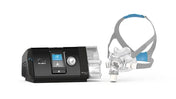
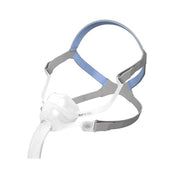
The AirFit F20 seals over both the nose and mouth, making it the appropriate choice for patients who breathe through their mouth during sleep. The InfinitySeal cushion is described by ResMed as proven to fit 97% of all faces, using an adaptive silicone design that contours to individual facial geometry. The cushion creates a seal along the nose bridge, cheeks, and below the mouth, and the soft, flexible frame sits beneath the eyes with integrated padding to reduce pressure points.
The F20 includes a quick-release elbow — a mechanism that allows the patient to disconnect from the CPAP tubing without removing the mask. This is a practical feature for patients who need to get up during the night, as it prevents the mask from being pulled off when moving away from the machine. The plush headgear is designed specifically for softness and stability, using magnetic clips to attach to the frame for guided, quick connection each night.
AirFit P10 — Nasal Pillow Mask
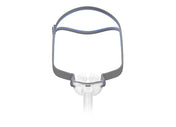
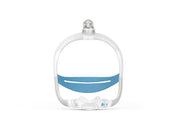
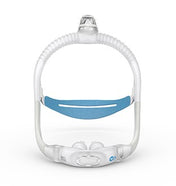
The AirFit P10 represents the opposite end of the face coverage spectrum. Its dual-wall nasal pillow cushions insert gently into the nostrils and form a seal at the nasal opening — the only points of contact with the face. There is no cushion around the nose, no frame across the cheeks, and no coverage of the mouth. The QuickFit auto-adjusting elastic headgear sits minimally on the back of the head, and the entire three-piece assembly is among the simplest in the CPAP mask market.
ResMed states the P10 is approximately 50% lighter than leading nasal pillow interfaces. Cushion sizes are colour-coded for easy identification, and three sizes — small, medium, and large — are included in the standard package. The P10 is not suitable for mouth breathers and will not function effectively if air escapes from the mouth during therapy.
Features and Technology Differences
Mouth Breathing and Pressure Tolerance
This is the primary clinical factor that differentiates these two mask categories. The AirFit F20 seals over both the nose and mouth, meaning it delivers therapy effectively regardless of whether the patient breathes nasally or orally during sleep. It is also the preferred choice at higher therapy pressures, where the sensation of air pressure can cause some patients to open their mouths involuntarily — a common issue when using nasal-only masks at elevated prescribed pressures.
The AirFit P10 seals only at the nostrils and provides no coverage of the mouth. Patients who breathe through their nose consistently throughout the night and whose prescribed pressure is tolerated without mouth breathing will find the P10 effective. Patients who are unsure about their breathing patterns during sleep should discuss this with their prescribing physician, as a poor mask-to-breathing-pattern match is one of the most common sources of CPAP therapy issues.
Face Contact and Comfort
The F20 makes contact with a significantly larger area of the face — the nose bridge, sides of the nose, cheeks, and the area below the mouth. The InfinitySeal cushion and padded frame are designed to minimise pressure and movement, but some patients find extended full face mask contact uncomfortable, particularly on the nose bridge or around the eyes. Marks on the face after removing the mask are more common with full face masks than with nasal pillow designs.
The P10 contacts the face only at the two nostrils and across the minimal elastic headgear. Patients who find any mask coverage on the cheeks, nose, or mouth uncomfortable — or who feel claustrophobic in full face designs — typically find the P10's minimal contact a significant relief. The dual-wall pillow design uses a trampoline action to maintain the seal with movement, so tight headgear tension is not required to compensate for positional shifts.
Quick-Release Elbow vs Standard Connection
The AirFit F20 includes a quick-release elbow that lets the patient disconnect from the CPAP tube without removing the mask — useful when getting up during the night or when adjusting position without fully disengaging from the machine. The AirFit P10 uses a standard front hose connection without an equivalent quick-release mechanism. The P10's three-piece simplicity means disconnection is still straightforward, but it does not include a dedicated quick-release feature.
Noise
The AirFit P10 features QuietAir woven-mesh venting, which diffuses exhalation airflow and reduces both sound and draft directed toward a bed partner. ResMed states the P10 is approximately 50% quieter than other leading nasal pillow interfaces. The AirFit F20 does not list a comparable venting technology or specific noise specification. For patients in shared sleeping environments who are particularly conscious of exhalation noise, this is a practical distinction to consider.
AirMini Compatibility
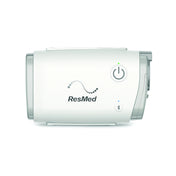
Both masks are compatible with the ResMed AirMini travel CPAP, making them practical options for patients who want to use the same mask interface across both home and travel therapy. The F20 requires the AirMini F20 setup pack and the P10 requires the AirMini P10 setup pack, both sold separately. Patients who use both a home machine and the AirMini regularly may find this shared compatibility a deciding factor in their mask selection.
Compatibility and What Is Included
ResMed
AirFit F20
- InfinitySeal silicone cushion (one size per purchase)
- Soft flexible frame with integrated padding
- Plush headgear with magnetic clips
- Quick-release elbow hose connector
- Fitting template available for size selection
- Suitable for mouth breathers and nasal breathers
- Compatible with all CPAP machines including the ResMed AirMini (setup pack required)
ResMed
AirFit P10
- Small, medium, and large nasal pillow cushions included (XS available separately)
- Colour-coded cushion sizing for easy identification
- Minimal lightweight frame with front hose connection
- QuickFit auto-adjusting elastic headgear with split-strap
- QuietAir woven-mesh venting for quiet operation
- Suitable for nasal breathers only
- Compatible with all CPAP machines including the ResMed AirMini (setup pack required)
Both masks are compatible with all CPAP machines from all manufacturers and follow the same Health Canada six-month replacement schedule. Replacement cushions, headgear, and elbow connectors for both masks are available through CPAP Machines Canada.
One packaging difference worth noting: the AirFit P10 includes three cushion sizes in the standard package, which reduces sizing guesswork for first-time buyers. The AirFit F20 is typically purchased in a single cushion size, guided by the fitting template. Patients who are unsure of their F20 cushion size should consult the fitting template or contact our team before ordering. Full AirFit F20 details are available on the product page and full AirFit P10 details are on its product page.
Which Users May Prefer Each Mask
The AirFit F20 may suit patients who:
- Breathe through their mouth during sleep, either habitually or as a result of CPAP therapy pressure
- Have a higher prescribed therapy pressure that makes nasal-only masks difficult to tolerate
- Experience nasal congestion, allergies, or a deviated septum that makes nasal breathing inconsistent
- Want the security of a seal that accommodates both nasal and oral breathing without requiring a chin strap
- Value a quick-release elbow for easy middle-of-the-night disconnection
- Have tried nasal or nasal pillow masks and experienced recurring air leaks from the mouth
The AirFit P10 may suit patients who:
- Breathe consistently through their nose during sleep
- Want the least amount of mask on their face and find full face masks claustrophobic or uncomfortable
- Are sensitive to pressure or contact on the nose bridge, cheeks, or around the mouth
- Share a bedroom and prioritise minimal exhalation noise with QuietAir venting
- Prefer fast, three-piece assembly and minimal parts to clean each day
- Want multiple cushion sizes included in the box without needing a fitting template first
Frequently Asked Questions
What is the main difference between the AirFit F20 and the AirFit P10?
The AirFit F20 is a full face mask that seals over both the nose and mouth, making it suitable for patients who breathe through their mouth during sleep. The AirFit P10 is a nasal pillow mask that contacts the face only at the nostrils, making it suitable for patients who breathe consistently through their nose. Beyond this fundamental difference in coverage, the masks also differ in face contact area, noise performance, cushion sizing approach, and headgear design.
Can I use the AirFit P10 if I sometimes breathe through my mouth?
The AirFit P10 seals only at the nostrils and does not cover the mouth. If air escapes from the mouth during therapy — whether due to habitual mouth breathing, high therapy pressure, or nasal congestion — the seal will not compensate and therapy effectiveness will be reduced. Patients who breathe through their mouth or who are uncertain about their breathing patterns during sleep should discuss this with their healthcare provider. The AirFit F20 or a chin strap paired with the P10 may be options worth considering in that situation.
Are both masks compatible with the ResMed AirMini travel CPAP?
Yes. Both the AirFit F20 and AirFit P10 are compatible with the ResMed AirMini when used with the appropriate setup pack — the AirMini F20 setup pack for the F20 and the AirMini P10 setup pack for the P10. Both setup packs are sold separately. This shared AirMini compatibility is a practical advantage for patients who travel and want to use the same mask interface with both their home and travel CPAP machines.
Will the AirFit F20 leave marks on my face?
Some patients experience temporary marks on the nose bridge, cheeks, or chin area after removing a full face mask, particularly when first adjusting to CPAP therapy or if headgear tension is set too high. The AirFit F20's InfinitySeal cushion and flexible padded frame are designed to minimise pressure, but some facial contact marks are common with full face mask designs and typically fade within an hour of removing the mask. If marks are persistent or uncomfortable, headgear tension and cushion fit should be reviewed — this is worth discussing with a CPAP specialist.
What does the quick-release elbow on the AirFit F20 do?
The quick-release elbow is a connector between the mask and the CPAP tubing that allows the patient to disconnect from the tube with a simple click — without removing the mask from the face. This is useful when getting up during the night, as it prevents the tube from pulling on the mask or being stepped on. It also makes it easier to roll over or reposition in bed without fully detaching from the machine. The AirFit P10 does not include an equivalent quick-release mechanism.
Which mask is better for a patient with nasal congestion or allergies?
The AirFit F20 is generally better suited to patients who experience frequent nasal congestion, seasonal allergies, or other conditions that make consistent nasal breathing difficult during sleep. Because it seals over both the nose and mouth, it continues to deliver therapy effectively even when nasal breathing is compromised. The AirFit P10 relies entirely on nasal breathing and will not deliver effective therapy if the nose is blocked or congested. Patients with chronic nasal issues should discuss mask selection with their healthcare provider.
How often should I replace either mask?
Health Canada recommends replacing CPAP mask components every six months. Both the InfinitySeal cushion on the F20 and the nasal pillow cushions on the P10 degrade over time, losing their sealing effectiveness and accumulating bacteria and organic material that cannot be fully removed by cleaning alone. Headgear also loses elasticity with regular use. Replacement components for both masks are available through CPAP Machines Canada.
Need Help Choosing the Right CPAP Mask?
If you have questions about the AirFit F20, the AirFit P10, or any other CPAP mask, our team is here to help. We can assist with mask type selection, sizing, AirMini compatibility, and finding the right fit for your breathing pattern and sleep habits.
CPAP Machines Canada
Website: cpapmachinescanada.ca
Toll Free: +1 (877) 820-4878
Email: support@cpapmachinescanada.ca