Introduction
Les patients qui souhaitent un contact minimal avec le visage pendant la thérapie CPAP se tournent souvent vers deux types de masques : les coussinets nasaux et les masques à berceau nasal. Le ResMed AirFit P10 est l'un des masques à coussinets nasaux les plus établis sur le marché, connu pour son poids ultra-léger, sa ventilation extrêmement silencieuse et son assemblage simple en trois pièces. Le ResMed AirFit N30i adopte une approche différente avec un coussin à berceau nasal et un raccord de tuyau au-dessus de la tête, offrant une empreinte faciale tout aussi minimale mais avec une zone d'étanchéité plus large et une plus grande liberté de mouvement pendant le sommeil.
Les deux masques proviennent du même fabricant, les deux comprennent plusieurs tailles de coussinets dans la boîte, et les deux sont conçus pour les patients qui trouvent les masques nasaux ou faciaux traditionnels trop volumineux ou intrusifs. Les différences entre eux — en termes de type de coussin, d'acheminement du tuyau, de conception du harnais et de compatibilité avec les machines — sont suffisamment importantes pour influencer le masque qui convient le mieux à un patient donné. Cet article compare les deux masques en se basant sur les informations produit publiées par le fabricant. Toute décision concernant votre masque ou votre configuration thérapeutique doit être prise en consultation avec votre professionnel de la santé ou votre spécialiste du sommeil.

Aperçu comparatif rapide
| Caractéristique | ResMed AirFit P10 | ResMed AirFit N30i |
|---|---|---|
| Catégorie de masque | Coussinets nasaux | Berceau nasal |
| Type de coussin | Coussinets nasaux à double paroi (s'insèrent dans les narines) | Berceau nasal (se positionne sous le nez) |
| Connexion du tuyau | Avant du masque | Dessus de la tête (connexion pivotante) |
| Harnais | Élastique auto-ajustable QuickFit, sangle fendue | Harnais standard |
| Cadre | Cadre minimal, léger | Cadre adaptatif SpringFit |
| Niveau sonore | Ventilation en maille tissée QuietAir — env. 50 % plus silencieuse que les masques à coussinets nasaux principaux | Non spécifié |
| Poids | Env. 50 % plus léger que les masques à coussinets nasaux principaux | Non spécifié |
| Tailles de coussin incluses | Petit, moyen, grand (TP disponible séparément) | Petit, petit-large, moyen (Pack de démarrage) |
| Code couleur de la taille | Oui — rose (TP), transparent (P), gris (M), bleu (G) | Non |
| Aide à l'ajustement | Identification des coussinets par code couleur | Gabarit d'ajustement PDF disponible |
| Nettoyage | Quotidien — eau chaude et savon doux | Quotidien — eau chaude et savon doux |
| Programme de remplacement | Tous les 6 mois (Santé Canada) | Tous les 6 mois (Santé Canada) |
| Compatible AirMini | Oui (avec le kit de configuration AirMini P10) | Non |
| Compatibilité avec d'autres machines | Toutes les machines CPAP | Toutes les machines CPAP sauf l'AirMini |
Les deux masques sont conçus pour minimiser le contact facial et conviennent aux patients qui bougent fréquemment pendant le sommeil. Les deux comprennent plusieurs tailles de coussinets dans la boîte et partagent la même routine de nettoyage quotidien. Les principales différences résident dans la manière dont le coussinet s'étanchéise contre le nez, l'emplacement de la connexion du tuyau et la compatibilité avec les machines CPAP.
Conception, type de coussin et ajustement
AirFit P10 — Coussinets nasaux
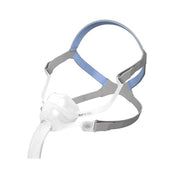
L'AirFit P10 utilise des coussinets nasaux — de petits inserts souples qui se logent juste à l'intérieur des narines pour créer un joint direct à l'ouverture nasale. Cette conception se traduit par l'empreinte la plus petite possible sur le visage et fait partie des masques CPAP les plus légers disponibles. ResMed note que le P10 est environ 50 % plus léger que les interfaces à coussinets nasaux principales, et sa construction en trois pièces — cadre, harnais et coussinet — rend l'assemblage, le retrait et le nettoyage extrêmement simples.
Les coussinets nasaux à double paroi utilisent ce que ResMed décrit comme une action de trampoline, fléchissant pour maintenir le joint lorsque l'utilisateur change de position pendant le sommeil. Le harnais QuickFit est un design élastique auto-ajustable avec une configuration à sangle fendue qui se positionne discrètement à l'arrière de la tête. Chaque taille de coussinet est codée par couleur — rose pour très petit, transparent pour petit, gris pour moyen et bleu pour grand — ce qui facilite l'identification des tailles lors du remplacement des coussinets ou de la commande de pièces de rechange.
AirFit N30i — Coussin à berceau nasal
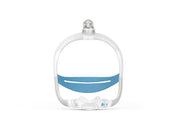
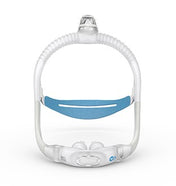
L'AirFit N30i utilise un coussin à berceau nasal qui se place sous le nez plutôt que de s'insérer dans les narines. Cela signifie que le joint est formé contre la peau sous le nez plutôt qu'à l'intérieur des ouvertures nasales, ce que certains patients trouvent plus confortable — en particulier ceux qui ressentent une sensibilité ou un inconfort avec les coussinets qui s'insèrent dans les narines. La conception du berceau offre toujours une expérience de contact minimal par rapport à un masque nasal complet, tout en offrant une surface d'étanchéité plus large qu'un coussinet nasal.
Le cadre SpringFit est conçu pour fléchir et s'adapter aux contours du visage de l'utilisateur, créant un ajustement sûr sans nécessiter une tension serrée du harnais. Dans une étude du sommeil citée par ResMed, 86 % des utilisateurs ont trouvé que le N30i s'étanchéisait de manière fiable, et 90 % l'ont trouvé facile à ajuster. Le pack de démarrage comprend trois tailles de coussinets — petit, petit-large et moyen — ce qui tient compte de la gamme plus large de largeurs faciales qu'un design de berceau doit prendre en compte.
Différences de caractéristiques et de technologie
Acheminement du tuyau : avant ou au-dessus de la tête
C'est l'une des différences pratiques les plus importantes entre les deux masques. L'AirFit P10 utilise une connexion de tuyau frontale, ce qui signifie que le tube s'étend de l'avant du masque vers l'extérieur. Pour la plupart des patients, il s'agit d'une configuration familière et sans problème, en particulier lorsqu'elle est utilisée avec une machine CPAP positionnée sur le côté du lit.
L'AirFit N30i utilise une connexion de tuyau au-dessus de la tête avec un pivot, acheminant le tuyau vers le haut et au-dessus de la tête. Cette conception élimine le tuyau du champ visuel immédiat du patient en position allongée et réduit considérablement la probabilité que le tube s'accroche à la literie ou tire sur le masque lorsque l'on se tourne d'un côté à l'autre. Pour les dormeurs actifs — en particulier ceux qui changent fréquemment de côté — la connexion au-dessus de la tête peut réduire le déplacement du masque et les ruptures d'étanchéité au milieu de la nuit. Elle rend également la lecture ou le visionnage de la télévision au lit plus confortable, car il n'y a pas de tube sur le visage ou la poitrine.
Niveau sonore
L'AirFit P10 est doté de la ventilation en maille tissée QuietAir de ResMed, qui disperse doucement le flux d'air d'expiration selon un motif diffus plutôt que de le diriger en un jet concentré. ResMed déclare que le P10 est environ 50 % plus silencieux que les autres interfaces à coussinets nasaux principales, et la ventilation est spécifiquement conçue pour diriger l'air loin du patient et du partenaire de lit. Il s'agit d'une caractéristique publiée et nommée avec une affirmation spécifique de réduction du bruit. L'AirFit N30i ne publie pas de spécification de bruit comparable ni de description de la technologie de ventilation.
Harnais et assemblage
Le harnais auto-ajustable QuickFit du P10 est conçu pour être enfilé sans ajustement — l'élastique s'adapte à une gamme de tailles de tête et s'étire pour s'adapter plutôt que de nécessiter un dimensionnement sangle par sangle. Les coussinets se clipsent dans le cadre avec un mécanisme de clip à clé en un clic, ce qui rend l'assemblage et le démontage rapides pour le nettoyage quotidien. Le N30i utilise son cadre SpringFit comme mécanisme principal d'adaptation à l'ajustement, avec un harnais standard qui s'ajuste par des sangles. Les deux systèmes sont conçus pour être simples, mais l'auto-ajustement élastique du P10 et les coussinets codés par couleur réduisent le nombre de décisions qu'un patient doit prendre lors de la configuration.
Compatibilité et contenu inclus
ResMed
AirFit P10
- Coussinets petits, moyens et grands inclus (TP disponible séparément)
- Coussinets avec code couleur pour une identification facile de la taille
- Cadre minimal avec connexion de tuyau frontale
- Harnais élastique auto-ajustable QuickFit avec sangle fendue
- Ventilation en maille tissée QuietAir
- Assemblage en trois pièces pour un nettoyage rapide
- Compatible avec toutes les machines CPAP, y compris le ResMed AirMini
ResMed
AirFit N30i
- Coussinets petits, petits-larges et moyens inclus (Pack de démarrage)
- Cadre adaptatif SpringFit
- Harnais réglable standard
- Connexion de tuyau pivotante au sommet de la tête
- Joint nasal sous le nez
- Gabarit d'ajustement PDF disponible
- Compatible avec toutes les machines CPAP, sauf le ResMed AirMini
Les deux masques comprennent plusieurs tailles de coussinets dans la boîte, ce qui réduit le risque de commander la mauvaise taille et permet aux patients d'essayer différentes options d'ajustement avant de choisir la bonne. Les deux suivent la même routine de nettoyage quotidien — eau chaude et savon doux — et le même programme de remplacement de six mois de Santé Canada pour les composants du masque.
Les coussinets de remplacement et les harnais pour l'AirFit P10 et l'AirFit N30i sont disponibles chez CPAP Machines Canada. Les patients qui souhaitent confirmer quels pièces de rechange sont compatibles avec leur masque spécifique doivent contacter notre équipe directement. Tous les détails de l'AirFit P10 sont disponibles sur la page du produit.
Quels utilisateurs pourraient préférer chaque masque
Les deux masques conviennent aux personnes qui respirent par le nez et qui préfèrent un contact minimal avec le visage pendant la thérapie. Les différences de type de coussin, d'acheminement du tuyau, de performance sonore et de compatibilité AirMini sont les principaux facteurs qui guideront la plupart des patients vers l'un ou l'autre.
L'AirFit P10 peut convenir aux patients qui :
- Veulent le masque le plus léger et le plus minimal disponible
- Privilégient un environnement de sommeil silencieux et veulent un masque avec une technologie de ventilation spécifique à faible bruit
- Sont à l'aise avec les inserts de coussinets nasaux et ne ressentent pas de sensibilité ou d'inconfort au niveau des narines
- Préfèrent un assemblage et un nettoyage rapides et simples avec un design en trois pièces
- Utilisent ou prévoient d'utiliser le CPAP de voyage ResMed AirMini en complément de leur machine domestique
- Veulent des coussinets à code couleur pour une identification et une commande faciles de la taille
L'AirFit N30i peut convenir aux patients qui :
- Trouvent les inserts de coussinets nasaux inconfortables ou ont une anatomie nasale qui rend l'utilisation des coussinets difficile
- Sont des dormeurs actifs qui se tournent fréquemment d'un côté à l'autre et veulent un acheminement du tuyau par le haut de la tête pour éviter les tiraillements du tube et le déplacement du masque
- Lisent, regardent la télévision ou utilisent un téléphone au lit avant de dormir et préfèrent qu'aucun tube ne passe sur le visage
- Veulent le contact d'étanchéité plus large d'un coussin à berceau sans la couverture complète d'un masque nasal
- N'utilisent pas le ResMed AirMini comme appareil de voyage
Foire aux questions
Quelle est la différence entre un coussinet nasal et un coussin à berceau nasal ?
Un coussinet nasal est composé de petits inserts souples qui se logent juste à l'intérieur des narines pour sceller directement à l'ouverture nasale. L'AirFit P10 utilise cette conception. Un coussin à berceau nasal se positionne sous le nez plutôt que de s'y insérer, formant un joint contre la peau sous les narines. L'AirFit N30i utilise cette conception. Les deux styles offrent un contact minimal avec le visage par rapport à un masque nasal complet, mais ils diffèrent par l'endroit et la manière dont le joint est formé. Les patients qui trouvent les inserts nasaux inconfortables trouvent souvent la conception à berceau plus adaptée, et vice versa.
Ces masques fonctionneront-ils avec mon CPAP de voyage ResMed AirMini ?
L'AirFit P10 est compatible avec le ResMed AirMini lorsqu'il est utilisé avec le pack de configuration AirMini P10, qui est vendu séparément. L'AirFit N30i n'est pas compatible avec le ResMed AirMini. Si vous utilisez ou prévoyez d'utiliser l'AirMini comme machine de voyage et que vous souhaitez utiliser le même masque à la maison et en déplacement, l'AirFit P10 est l'option compatible entre ces deux-là.
Pourquoi l'AirFit N30i achemine-t-il le tuyau au-dessus de la tête ?
La connexion du tuyau au-dessus de la tête sur le N30i achemine le tuyau CPAP vers le haut et loin du visage, réduisant le risque que le tube s'accroche à la literie ou tire sur le masque lorsque l'on se retourne pendant le sommeil. Cette conception est particulièrement utile pour les dormeurs actifs qui changent fréquemment de position tout au long de la nuit. Elle éloigne également le tube du champ de vision du patient en position allongée, ce que certains utilisateurs trouvent plus confortable pour lire ou s'installer avant de dormir.
À quel point l'AirFit P10 est-il plus silencieux par rapport aux autres masques à coussinets nasaux ?
ResMed déclare que l'AirFit P10 est environ 50 % plus silencieux que les autres interfaces à coussinets nasaux principales. Cela est rendu possible grâce au système de ventilation en maille tissée QuietAir, qui disperse doucement le flux d'air d'expiration dans plusieurs directions plutôt que de diriger un jet concentré vers le partenaire de lit. L'AirFit N30i ne publie pas de spécification de bruit équivalente.
Quelles tailles de coussinets sont incluses avec chaque masque ?
L'AirFit P10 comprend des coussinets nasaux de tailles petite, moyenne et grande. Un coussinet très petit est disponible séparément. Chaque taille est codée par couleur pour une identification facile. Le pack de démarrage AirFit N30i comprend des coussinets à berceau nasal de tailles petite, petite-large et moyenne. La taille petite-large convient aux patients dont le nez se situe entre les incréments de taille standard. Les deux masques comprennent un outil d'ajustement ou un gabarit pour aider à déterminer la bonne taille avant de s'engager sur un seul coussinet.
Ces masques conviennent-ils aux patients qui respirent par la bouche ?
Non. L'AirFit P10 et l'AirFit N30i sont des conceptions nasales à contact minimal qui scellent au niveau ou sous le nez. Ils nécessitent une respiration nasale pour maintenir un joint efficace et fournir une thérapie complète. Si la respiration buccale se produit lors de l'utilisation de l'un ou l'autre de ces masques, l'air s'échappera de la bouche et l'efficacité de la thérapie sera compromise. Les patients qui respirent par la bouche ou qui souffrent de respiration buccale pendant le sommeil doivent discuter des options de masque facial complet ou d'une solution de mentonnière avec leur professionnel de la santé.
À quelle fréquence dois-je remplacer l’un ou l’autre masque?
Santé Canada recommande de remplacer les composants des masques CPAP tous les six mois. Avec le temps, les matériaux des coussins – qu'il s'agisse des coussins narinaires ou des berceaux narinaires – s'étirent et perdent leur capacité à maintenir une étanchéité constante. Les harnais perdent également de leur élasticité avec une utilisation régulière. Les bactéries et les matières organiques s'accumulent quelle que soit la fréquence de nettoyage, rendant un remplacement régulier important pour l'hygiène ainsi que pour la performance. Les composants de remplacement pour les deux masques sont disponibles chez CPAP Machines Canada.
Besoin d'aide pour choisir le bon masque CPAP?
Si vous avez des questions sur l'AirFit P10, l'AirFit N30i ou tout autre masque CPAP, notre équipe est là pour vous aider. Nous pouvons vous aider avec le dimensionnement des coussins, la compatibilité avec votre appareil CPAP et le choix du style de masque adapté à vos habitudes de sommeil et à vos préférences de confort.
CPAP Machines Canada
Site web: cpapmachinescanada.ca
Numéro sans frais: +1 (877) 820-4878
Courriel: support@cpapmachinescanada.ca