Introduction
When patients with sleep apnea explore CPAP masks, one of the earliest and most important decisions is how much mask they want on their face. The ResMed AirFit P10 and the ResMed AirFit N20 both come from the same manufacturer and both serve nasal breathers — but they represent two different categories of mask entirely. The AirFit P10 is a nasal pillow mask, inserting small cushions just inside the nostrils for the smallest possible facial footprint. The AirFit N20 is a nasal mask, using a silicone cushion that covers and seals around the outside of the nose.
The choice between these two mask types is one of the most common questions new CPAP patients ask, and experienced users switching masks often consider it too. Both masks are highly regarded within their categories, both include multiple cushion sizes, and both are compatible with the ResMed AirMini travel CPAP. The differences lie in comfort at the sealing point, the amount of face coverage, noise performance, headgear design, and how each mask behaves with movement during sleep. This article covers those differences based on manufacturer-published product information. Consult your healthcare provider or sleep specialist before making changes to your therapy setup.

Quick Comparison Overview
| Feature | ResMed AirFit P10 | ResMed AirFit N20 |
|---|---|---|
| Mask Category | Nasal pillow | Nasal mask |
| Cushion Type | Dual-wall nasal pillows (insert into nostrils) | InfinitySeal silicone (seals around the nose) |
| Face Coverage | Minimal — pillows only at nasal openings | Covers and seals around the full nose |
| Hose Connection | Front of mask | Front of mask |
| Headgear | QuickFit auto-adjusting elastic, split-strap | Magnetic clips, soft flexible frame with integrated padding |
| Magnets | No magnets listed | Magnetic clips |
| Noise | QuietAir woven-mesh venting — approx. 50% quieter than leading nasal pillow masks | Not specified |
| Weight | Approx. 50% lighter than leading nasal pillow masks | Not specified |
| Cushion Sizes Included | Small, Medium, Large (XS available separately) | Varies by purchase — fitting template guides size selection |
| Colour-Coded Sizing | Yes | No |
| Cushion Interchangeable | No | Yes — compatible with AirTouch N20 memory foam cushion |
| Fit Philosophy | Auto-adjusting elastic headgear, colour-coded pillows | "No rules fit" — modular design, magnetic clip headgear |
| Cleaning | Daily — warm water and mild soap | Daily — warm water and mild soap |
| Replacement Schedule | Every 6 months (Health Canada) | Every 6 months (Health Canada) |
| AirMini Compatible | Yes (with AirMini P10 setup pack) | Yes (with AirMini N20 setup pack) |
| Other Machine Compatibility | All CPAP machines | All CPAP machines |
Both masks are built by ResMed, are compatible with all CPAP machines including the AirMini, and follow the same cleaning and replacement schedule. The core distinction is the mask category itself — a nasal pillow versus a nasal mask — and the practical differences that flow from that choice.
Design, Cushion Type, and Fit
AirFit P10 — Nasal Pillow Design
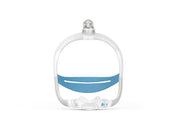
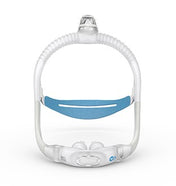
The AirFit P10 uses dual-wall nasal pillow cushions that insert gently into the nostrils to form a seal directly at the nasal opening. This results in the smallest possible amount of mask on the face — there is no frame covering the nose, no cushion pressing against the skin around the nose bridge or sides, and the headgear sits minimally on the back of the head using an auto-adjusting elastic split-strap design.
ResMed states the P10 is approximately 50% lighter than leading nasal pillow interfaces, and the three-piece construction — frame, cushion, and headgear — means assembly and cleaning are extremely quick. Cushion sizes are colour-coded for easy identification: pink for extra small, clear for small, gray for medium, and blue for large. The dual-wall pillow design uses a trampoline action that flexes to maintain the seal as the user moves, without requiring tight headgear tension to compensate for positional shifts.
AirFit N20 — Nasal Mask Design
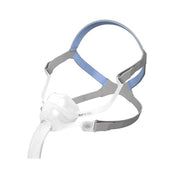
The AirFit N20 uses ResMed's InfinitySeal cushion, a silicone design that seals around the outside of the nose rather than inserting into the nostrils. This means the mask covers a broader area of the face — the cushion contacts the skin on the sides of the nose and the area between the nose and upper lip. For patients who find pillow insertion uncomfortable or who have difficulty achieving a consistent seal with pillows, the N20's external seal approach is often more reliable.
The N20 uses a soft, flexible frame with integrated padding and magnetic clips that connect the headgear to the frame quickly and securely. ResMed describes the N20 as a "no rules fit" mask — there is no specific technique required to put it on correctly, and the modular design is intended to be intuitive even for new users. The frame moves with the face rather than pressing rigidly against it, which helps maintain the seal when the user rolls during sleep.
Features and Technology Differences
Face Contact and Claustrophobia
One of the most commonly cited reasons patients choose a nasal pillow mask over a nasal mask is reduced face contact. The AirFit P10 touches the face only at the two nasal openings and across the minimal headgear straps. Patients who feel claustrophobic in traditional masks, who find pressure against the nose bridge or cheeks uncomfortable, or who wear glasses before sleep and want an unobstructed field of view often find nasal pillow designs significantly more comfortable in this regard.
The AirFit N20 covers more of the face by design, which is necessary for the external seal to function. However, the InfinitySeal cushion and flexible frame are engineered to apply the minimum pressure needed for an effective seal — the mask is designed to rest lightly rather than press firmly. For patients who tolerate nasal mask coverage well, the broader sealing surface of the N20 can actually make it easier to maintain a consistent seal across different sleep positions and facial profiles.
Noise and Venting
The AirFit P10 features QuietAir woven-mesh venting, which ResMed states makes it approximately 50% quieter than other leading nasal pillow interfaces. The mesh disperses exhalation air diffusely rather than directing it in a concentrated stream, reducing both audible noise and the sensation of exhalation draft near a bed partner. This is a published, named technology with a specific performance claim. The AirFit N20 does not list a comparable venting technology or noise specification in its product information.
Headgear and Assembly
The P10's QuickFit headgear is a single elastic piece that auto-adjusts to head size without requiring strap-by-strap fitting. The cushions attach with a one-click key-clip mechanism. The overall result is a mask that can be assembled, worn, and disassembled very quickly with minimal parts to manage. The N20's magnetic clip headgear connects the straps to the frame with a satisfying, guided click that makes reattachment quick each night. The N20 has slightly more components than the P10 but remains a simple, modular system designed to be put on without any particular technique.
AirMini Compatibility
Both masks are compatible with the ResMed AirMini travel CPAP, which sets them apart from several other mask options on the market. The AirFit P10 requires the AirMini P10 setup pack and the AirFit N20 requires the AirMini N20 setup pack, both available separately. This compatibility means patients can use either mask with both their home CPAP machine and their AirMini travel device, maintaining the same mask interface across both setups.
Compatibility and What Is Included
ResMed
AirFit P10
- Small, medium, and large nasal pillow cushions included (XS available separately)
- Colour-coded cushions for easy size identification
- Minimal lightweight frame with front hose connection
- QuickFit auto-adjusting elastic headgear with split-strap design
- QuietAir woven-mesh venting for quiet operation
- Three-piece assembly for fast daily cleaning
- Compatible with all CPAP machines including the ResMed AirMini (setup pack required)
ResMed
AirFit N20
- InfinitySeal silicone cushion (one size per purchase — fitting template guides selection)
- Soft flexible frame with integrated padding
- Headgear with magnetic clips
- Short hose connector included
- Cushion interchangeable with AirTouch N20 memory foam cushion
- Compatible with all CPAP machines including the ResMed AirMini (setup pack required)
Both masks are compatible with all CPAP machines from all manufacturers and follow the same Health Canada six-month replacement schedule. Replacement cushions and headgear for both the AirFit P10 and AirFit N20 are available through CPAP Machines Canada.
One practical packaging difference worth noting: the AirFit P10 includes three cushion sizes in the box as standard. The AirFit N20 is typically sold with one cushion in the chosen size, guided by the fitting template. Patients who are unsure of their N20 cushion size may wish to confirm sizing with our team before ordering to avoid needing an exchange. Full AirFit P10 details are available on the product page and full AirFit N20 details are on its product page.
Which Users May Prefer Each Mask
The AirFit P10 may suit patients who:
- Want the least amount of mask on their face during sleep
- Feel claustrophobic in masks that cover the nose
- Are sensitive to pressure on the nose bridge or cheeks
- Want a mask that is easy to wear with glasses before sleep
- Prioritise a quiet, partner-friendly venting system
- Prefer fast, minimal three-piece assembly and cleaning
- Are comfortable with nasal pillow inserts and experience no nostril sensitivity
The AirFit N20 may suit patients who:
- Find nasal pillow inserts uncomfortable or experience nostril soreness
- Have difficulty maintaining a consistent seal with nasal pillows
- Breathe heavily through the nose and benefit from a broader sealing area
- Want the option to switch between silicone and memory foam cushions in the same frame
- Are new to CPAP and prefer the broader seal area that nasal masks typically provide for first-time fitters
- Have a facial profile that responds better to an external seal than an internal pillow
Frequently Asked Questions
What is the difference between a nasal pillow mask and a nasal mask?
A nasal pillow mask uses small cushions that insert gently into the nostrils to form a seal at the nasal opening. The AirFit P10 is this type. A nasal mask uses a cushion that seals around the outside of the nose, covering and sealing the nose without inserting into the nostrils. The AirFit N20 is this type. Nasal pillow masks have less face contact and are generally lighter, while nasal masks offer a broader sealing surface that some patients find more reliable or comfortable.
Are both masks compatible with the ResMed AirMini?
Yes. Both the AirFit P10 and AirFit N20 are compatible with the ResMed AirMini travel CPAP. The P10 requires the AirMini P10 setup pack and the N20 requires the AirMini N20 setup pack, both sold separately. This shared AirMini compatibility is notable — many nasal masks on the market are not compatible with the AirMini, making the P10 and N20 practical choices for patients who want a consistent mask experience across both home and travel therapy.
Which mask is quieter — the P10 or the N20?
The AirFit P10 features QuietAir woven-mesh venting, which ResMed states makes it approximately 50% quieter than other leading nasal pillow interfaces. This is a published, specific noise reduction claim tied to a named venting technology. The AirFit N20 does not publish a comparable noise specification. Patients who share a bedroom and prioritise minimal noise from exhalation airflow may find the P10's documented venting performance relevant to their decision.
Can I switch between the P10 and N20 cushion on the same mask frame?
No. The AirFit P10 and AirFit N20 use different frames and are not interchangeable with each other. However, the AirFit N20 frame is compatible with both the AirFit N20 silicone cushion and the AirTouch N20 memory foam cushion, which click into the same frame. This gives N20 users the option to switch cushion materials without replacing the full mask system. The P10 does not have an equivalent interchangeable cushion alternative.
I am new to CPAP therapy — which mask should I start with?
There is no universal answer, as mask preference is highly individual. Some patients find the minimal contact of a nasal pillow mask immediately comfortable, while others find the pillow inserts take adjustment and prefer starting with a nasal mask. New patients often benefit from trialling both types early in their therapy to find what suits their face and sleep habits. Our team at CPAP Machines Canada is available to discuss your specific situation and help guide your mask selection before you purchase.
How do I find the right cushion size for each mask?
The AirFit P10 includes small, medium, and large cushion sizes in the standard package, allowing you to try each size and identify the best fit. An extra small size is available separately. Each size is colour-coded for easy identification. The AirFit N20 uses a downloadable PDF fitting template to guide cushion size selection before purchase. If you are uncertain about sizing for the N20, our team can assist before you place your order.
How often should I replace either mask?
Health Canada recommends replacing CPAP mask components every six months. Both nasal pillow cushions and nasal mask cushions lose their shape and sealing ability over time, and headgear elasticity degrades with regular use and cleaning. Bacteria and organic material also accumulate on mask surfaces regardless of cleaning frequency. Replacement cushions and headgear for both the AirFit P10 and AirFit N20 are available through CPAP Machines Canada.
Need Help Choosing the Right CPAP Mask?
If you have questions about the AirFit P10, the AirFit N20, or any other CPAP mask, our team is here to help. We can assist with sizing, compatibility with your machine, and finding the right mask type for your comfort and sleep habits.
CPAP Machines Canada
Website: cpapmachinescanada.ca
Toll Free: +1 (877) 820-4878
Email: support@cpapmachinescanada.ca